The stack of clothes to mend has been piling up. Much of it might be hopeless. Nothing proved this more than when I paid to have some jeans repaired. I wasn’t expecting to feel the crusty glue that was used to secure (temporarily) a scratchy stiff knee patch. Is it just me? Do I have pointy knees?
Trying to repair my pants on my own did not produce better results. Instead, I had nothing to show for my toiling expect for a tool that might prove to be useful, which is why it is taking up space in my house. To make it, I cut a hole in a couple of sides of a square bottle, with the idea that I could pull a pant leg over it and thereby separate the front and back and get access to the damaged part with a needle. Cutting a hole on one side of a bottle and the bottom of the bottle worked better. Burning the edges (I’m not sure what I used – maybe a heat gun?) made them smooth and less prone to snagging. Nevertheless, it amounted to more toiling for little (no) payoff.

There’s a point at which one must give up. But then another idea struck me. The inspiration came from three places. First, in woodworking, to repair something with a jagged edge, sometimes you have to cut out a bigger piece so that you have a straight line with with to work. The same is true of a jagged hole in drywall. To repair it, first cut out an even bigger hole around the hole to be repaired so that you can make a patch that has straight edges. In the case of my pants with a hole in the knee, I wondered if I could cut out a section of the pant leg so that I’m not only dealing with a straight edge, but I am working with an edge as opposed to trying to access the middle of the pant?
This got me thinking about the pillow cases with French seams. To make them, instead of sewing right sides together, you first sew wrong-sides together and then make another pass, sewing right sides together to secure/hide the seam allowance. Also, because I’ve made a bolster and therefore have at least touched on sewing a tube together, I knew enough to experiment.
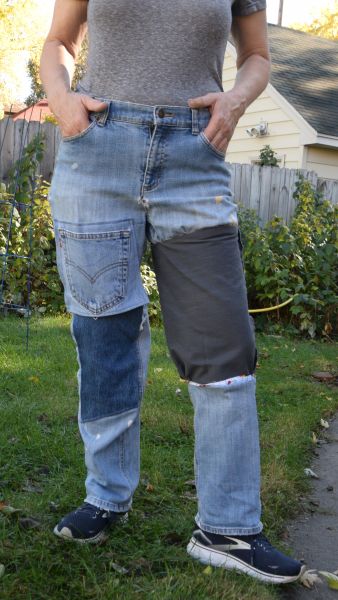
Making a quick example using a hopeless pair of jeans from the sewing pile, I cut out a section of the left pant leg and replaced it with a “tube” from an old pair of Brian’s pants (the dark gray part in the picture above). The result was not great and the gray was a regrettable choice. But with a little more fussing (and measuring), it should be possible to use this method to repair jeans such that they are not only serviceable to wear for gardening or painting or doing other dirty jobs, you might even make something cool, especially when combined with the patchwork job on the right leg (with the back pocket showing), which is a fail for other reasons.
Or it might be time to try what the professionals do (if not gluing patches to the knee, ahem), which is to get access to a hole by ripping out the seams of a pant leg, making the repair, and then sewing everything back together again (Scott Bennett’s version of “I’m going to take it apart and glue it back together again” on the Fixing Furniture YouTube channel). With access to the right tools (a serger, perhaps?) and people who know what they’re doing at a Fix-It clinic, maybe I will.
Whether the core material is worth saving is another story. What’s the point of patching a knee when there’s nothing left of the waistband?
Note about AI
I will never knowingly link to AI slop. If you ever get the impression that I might’ve done this in error, please let me know.
Cool looking jeans–I like them. I’m down to one pair of yard/work jeans and as usual I wait too long before I do anything about the huge holes in the knee area and without much effort and one big snip with the scissors I have a new pair of yard shorts.